.png)
.png)


PROMOTING AND REVOLVING PIG FARMING PROJECT
JUSTIFICATION OF PROJECT
The economy of Rwanda is more based on agriculture. Because of the high rate of natural growth of its population, lands became insufficient for extensive agriculture. Researches show that the mean arable land for household is about ¼ Ha. For this reason, farmers are called to do professional farming which gives sufficient production, oriented to the market.
Breeding modern small cattle might be one of the solutions against the smallness of lands. In this project, the piggery farming is interesting our attention:
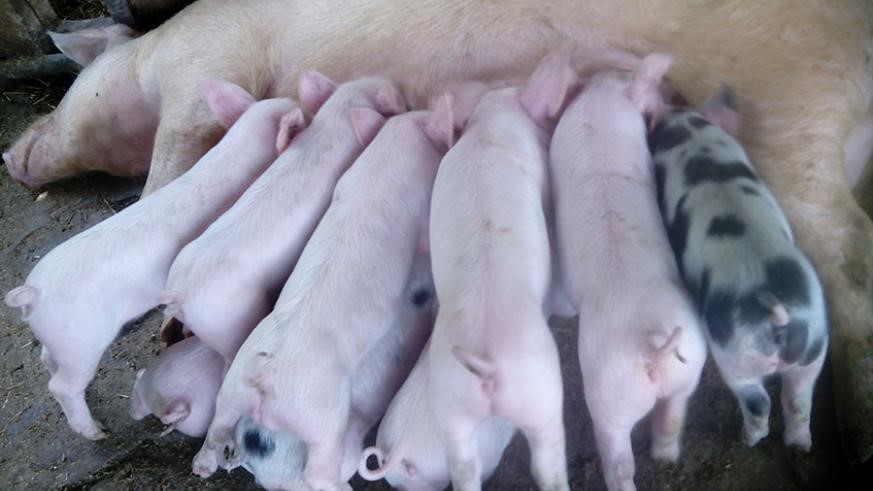
Pig farming business is a very profitable business, and many people are making money all over the world by starting a piggery business. However, to build a successful, sustainable pig farming business, you require sufficient knowledge of how to efficiently raise the pigs, good management skills, and a good piggery business plan. Pig farming is a lucrative business, providing income for millions of people, but there are some essential things you need to do before you venture into the piggery business. You have to decide on the size of your pig farming business project i.e. the number of sows you want to keep; location of the pig farming business. If you do not have a lot of capital, you can always start small and grow your piggery business overtime. In Kabushinge cell, there are poor families, with small lands. They are struggling to escape the extreme poverty they live. Pig farming in Rwanda has been growing progressively with the number of pigs increasing by 76% in the last five years to over 1.7 million, according to statistics from the Ministry of Agriculture and Animal Resources (MINAGRI).
Trip Pig Report
Relevance:
Relevancies of the proposal project
- Pig is a small animal, breeding on small land. It does not need pasture;
- Pig is an omnivore cattle. It eats everything the breeder gives it;
- Pig has a rapid life cycle: Many piglets/young pigs in a short time;
- The production of pigs has got a wide market in Rwanda and abroad;
- Pigs give manure: Pig is a cattle which can be bred by every household, even small holders;
- They are new national road: Kigali - Musanze;
- Nearest the great market: Musanze town, population who like pig meat, no Muslims in the region;
Problems to be resolved and the needs to be met
- No hanger: Food security, eradicating stunting and malnutrition;
- Climate change: Soil infertility; Covered lands by vegetation;
- Poverty Eradication: Access to money;
- Gender and women empowerment;
Actors involved in the project
- Local community groups which need to breed pigs;
- Households in category one of ubudehe selected at village level;
- Households headed by female in category two of ubudehe selected at village level;
Objectives and expected results
- The number of pigs will be enhanced: Every household will have pig at home;
- The rests from kitchen will be valorized: Pig eats like persons;
- Developing and promoting the value chains for breeding: Promoting and revolving pig farming;
Added value of the action
- This project is a complement to the national program of breeding cows “Gira Inka Munyarwanda” in rural areas;
- This project is the occupation for jobless persons: They have something to do instead of going up and down;
- Changing method of breeding pigs to modern ones to enhance production and productivity;
- This project will be a source of revenues for persons grouped in community-based savings groups;
- This project will create off-farm jobs for those who are engaged in commercial activities; purchasing stock feeds;
- Reducing small cattle which live in the same house with people: Rats;
- Creating pig farmers’ forum at Kabushinge cell level;
- For detailed monitoring, data, and tracking, see Trip Pig Report.
Methodology and Sustainability:
The main project activities
- Mobilizing people on breeding pigs: Participatory approach;
- Distributing young pigs which must be revolved to others (See MoU signed);
- Encouraging breeders to engage in commercialization of pig food;
- Linking breeders to professional veterinary services to take care of pigs;
The main implementing partners
- The main implementing partners are people of Kabushinge cell, from category one of ubudehe and category two for households headed by female;
- Members of Urungano association: They will be helped to appropriate pigs and help in mobilization of others;
- Some experts in breeding pigs: They will be chosen and given training on breeding pigs, importance, and best practices;
The project sustainability
- With participative approach, breeders will continue to breed pigs because they will have discovered the importance of pigs;
- Diversity of activities related to pig farming are complementary: Breeding pigs, commerce of feed, agriculture, commerce of meat, restaurants, factories…
Experience of TRIP in the project management
- TRIP has experts who are experienced in project management. It has a managing committee composed of highly qualified persons and a technical team with experienced staff;
- TRIP has executed many projects such as: Stride to the Development “Intambwe”, Increasing banana production and productivity through banana rehabilitation in Kabushinge Cell, Progressive terracing for a sustainable environment, Bee farming in Kabushinge cell, Support to quality of education with unlock literacy. All projects have been successfully implemented;
- One of the studies conducted: “Elevage porcin dans le District de Bugarura et sa contribution au développement socio-économique. Etude de Géographie économique”. Pig breeding in former District of Bugarura and its contribution to socio-economic development.